Guide · ESP · Buyer’s guide
Which ESP should you actually buy?
There used to be one ESP8266. Now there’s a whole lineup — ESP32, S2, C3, S3 — and it’s easy to get lost. Here’s the short version: what actually differs between them, and the right pick for your project.
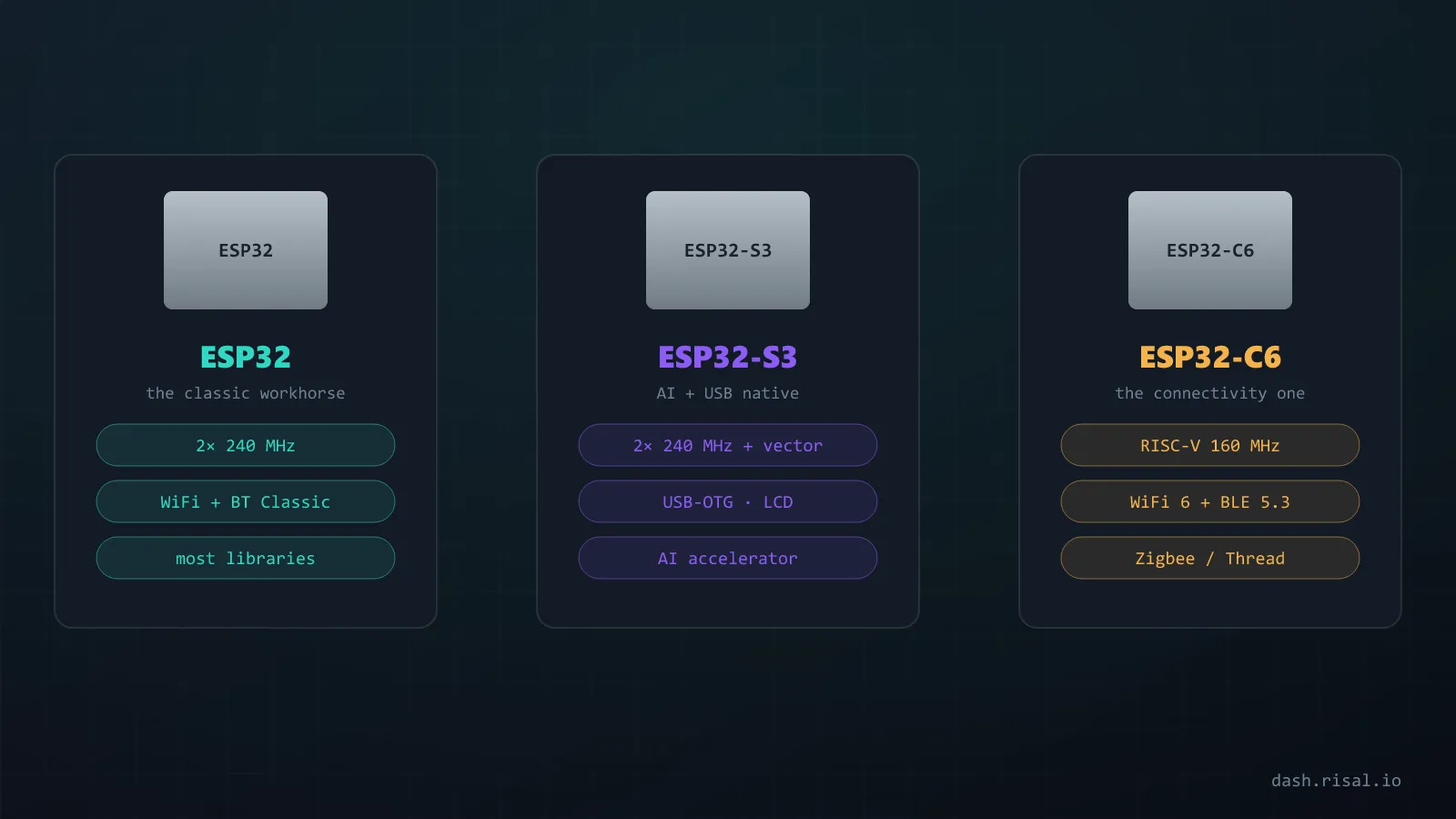
The lineup at a glance
| Chip | Core(s) | Radio | USB |
|---|---|---|---|
| ESP8266 | Single Xtensa L106 · 80/160 MHz | Wi-Fi b/g/n | via CH340/CP2102 |
| ESP32 | Dual Xtensa LX6 · 240 MHz | Wi-Fi + BT Classic + BLE | via serial chip |
| ESP32-S2 | Single Xtensa LX7 · 240 MHz | Wi-Fi only (no BT) | native USB-OTG |
| ESP32-C3 | Single RISC-V · 160 MHz | Wi-Fi + BLE 5 | native USB |
| ESP32-S3 | Dual Xtensa LX7 · 240 MHz | Wi-Fi + BLE 5 | native USB-OTG |
Which one for your project
- ESP8266 — Cheapest Wi-Fi. The DIY legend — huge community, works everywhere.
- ESP32 — The all-rounder. Most GPIO, both cores, Bluetooth Classic — the safe default.
- ESP32-S2 — Native USB, low power, lots of GPIO — but no Bluetooth at all.
- ESP32-C3 — The modern ESP8266 replacement: cheaper, BLE, native USB, RISC-V.
- ESP32-S3 — PSRAM + AI/vector ops. For cameras, displays, audio and on-device ML.
Xtensa vs RISC-V — does it matter?
The older ESP8266/ESP32/S2/S3 use Espressif’s Xtensa cores; the C3 (and newer C6/H2) use open RISC-V. For an Arduino or ESP-IDF user this barely matters — you write the same C++ and the toolchain hides the difference. It’s a strategic move by Espressif, not something that changes your sketch.
The gotchas that actually decide it
- Native USB vs a serial chip. C3/S2/S3 have USB built into the chip (flash and debug straight over USB, act as a keyboard/MIDI device). ESP32 and ESP8266 need an onboard CH340 or CP2102.
- One core or two. ESP32 and S3 are dual-core; C3, S2 and ESP8266 are single-core. Matters if you want Wi-Fi on one core and your logic on the other — see how these buses feed that logic.
- Bluetooth. ESP8266 and S2 have none. ESP32 has Classic + BLE; C3/S3 have BLE 5 only. Need BLE? Skip the S2.
- GPIO count. ESP8266 gives you only ~9–11 usable pins (and some are picky at boot); the ESP32 family has far more.
- PSRAM. The S3 (and some ESP32) add external PSRAM — essential for camera frames, big displays and ML buffers.
Short answer: ESP32 if unsure, C3 for a cheap modern USB+BLE board, S3 for camera/display/AI, ESP8266 only to squeeze the last cent. Whatever you pick, it speaks the same buses — and needs the same solid power to stay stable on Wi-Fi.
Every one of these serves a RisalDash web dashboard in a few lines of C++.