Guide · Matter · Smart Home
Matter & Thread on the ESP32-C6
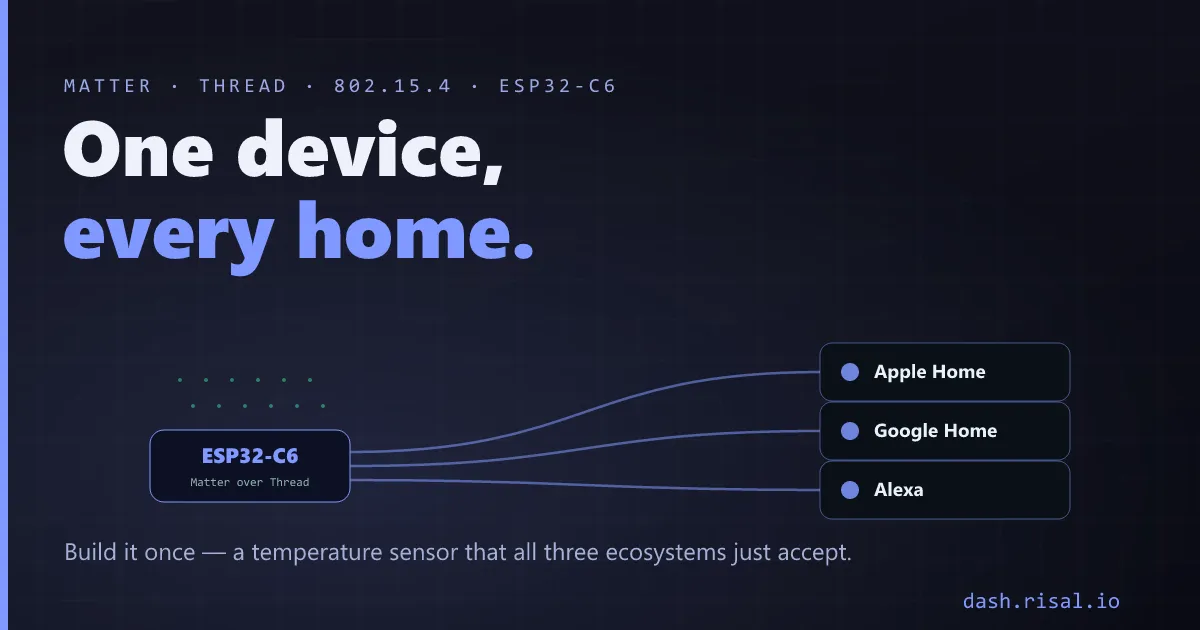
For years a smart-home gadget worked with one ecosystem and sulked at the others. Matter ends that: build a sensor once and Apple Home, Google Home and Alexa all accept it — carried over Thread, a low-power mesh. And the ESP32-C6 is the cheap chip that finally speaks the radio. Here’s how the pieces fit.
Why Zigbee is fading — and what replaces it
Zigbee proved the idea — cheap, low-power mesh sensors — but every vendor built a slightly different dialect, so devices needed a matching hub and rarely crossed brands. Matter is the shared application language the big players agreed on; Thread is the low-power IPv6 mesh it usually rides. Think of it as two layers: Matter is what the device says (“I’m a temperature sensor, here’s 23 °C”), Thread is how the packet travels. Together they finally deliver cross-brand smart home.
The radio: which ESP actually speaks it
Matter-over-Thread needs an 802.15.4 radio — the same band family as Zigbee, and not something a classic ESP32 or ESP8266 has. Two newer chips add it:
| Chip | Radios | Best role |
|---|---|---|
| ESP32-C6 | Wi-Fi 6 + BLE + 802.15.4 | Matter device or a Wi-Fi bridge |
| ESP32-H2 | BLE + 802.15.4 (no Wi-Fi) | pure Thread/Zigbee sensor, lowest power |
| Classic ESP32 / S3 | Wi-Fi + BLE | Matter-over-Wi-Fi only (no Thread) |
| ESP8266 | Wi-Fi | no Matter |
So the C6 is the sweet spot — it can be a Thread device and still fall back to Wi-Fi. See the chip guide for the wider family, and the protocols overview for where Thread sits next to Wi-Fi, BLE and LoRa.
Build once, visible everywhere
The practical payoff: flash a temperature (or contact, or plug) device once with Espressif’s Matter SDK, commission it by scanning a QR/setup code, and it shows up natively in Apple Home, Google Home, Alexa and Home Assistant at the same time — no per-ecosystem integration, no cloud account per brand. Update the reading and every controller sees it. That “commission once, controllers just work” flow is the whole reason Matter exists.
The catch: you still need a border router
Thread is a mesh with no internet of its own, so it needs a Thread border router to bridge the mesh to your LAN — but you probably already own one: a HomePod mini, an Apple TV, a newer Nest/Echo hub, or a Home Assistant Thread add-on all count. Mains-powered Matter devices also relay for their neighbours, so the mesh heals and stretches as you add nodes. If you don’t want a border router at all, a classic ESP32 can still do Matter-over-Wi-Fi — same language, no Thread.
Prefer Wi-Fi and your own UI? A live dashboard served straight from the chip.