
Guide · RISC-V · Chips
The quiet RISC-V takeover
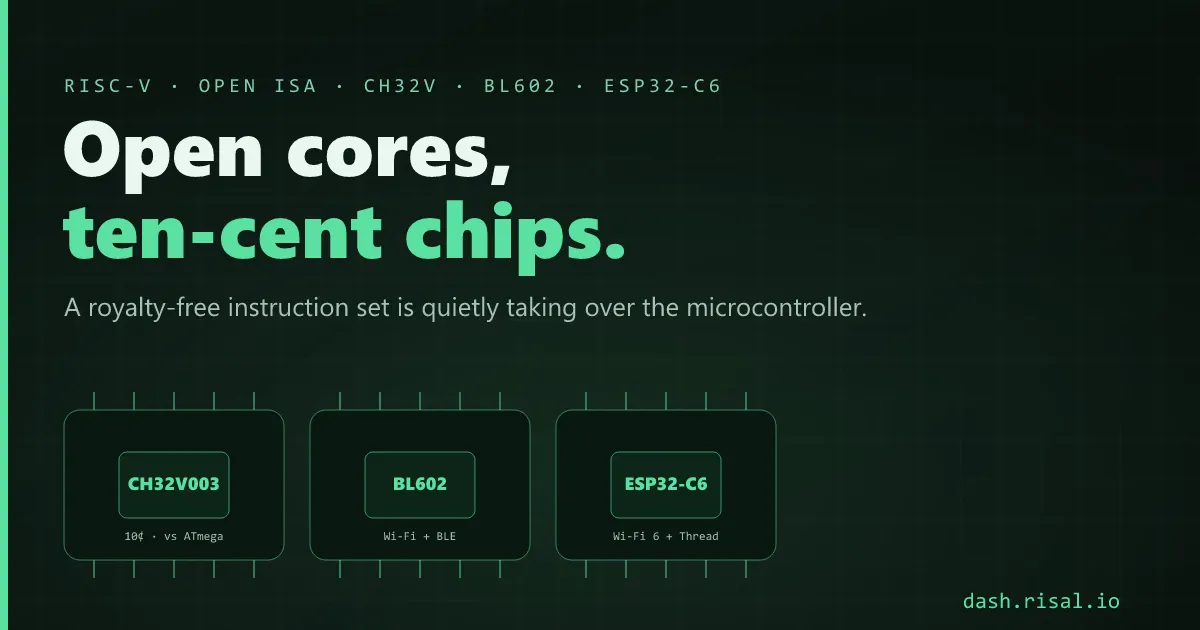
Under the hood, the chips you buy are switching cores. RISC-V — an open, royalty-free instruction set — is replacing proprietary ones like ARM and Xtensa, and it’s already in your parts bin: the ESP32-C3 and C6 run it, and ten-cent newcomers like the CH32V003 are undercutting the classic ATmega. Here’s why it’s happening and what it means for what you build.
Why RISC-V, and why now
An instruction set is the contract between the compiler and the silicon. ARM and Xtensa are proprietary — chipmakers pay to license them. RISC-V is open and free: anyone can build a core with zero royalties, which pushes prices down and lets small vendors ship silicon. For you it’s mostly invisible — the same C++ compiles — but it’s why microcontrollers keep getting cheaper and more varied. On the ESP side it’s the split between the Xtensa classics and the newer RISC-V parts in the chip guide.
The ten-cent chips vs the ATmega
The headline is price. The CH32V003 is a RISC-V MCU that sells for around ten cents — a fraction of an ATmega328 (the classic Arduino Uno chip) — yet is faster and often has more flash. For a blinker, a fan controller, a bit of glue logic, it’s almost too cheap to think about. You give up the huge Arduino ecosystem the ATmega enjoys, but the gap is closing fast.
RISC-V with radios: ESP32-C3 / C6
RISC-V isn’t only the bargain basement. Espressif’s ESP32-C3 is a RISC-V core with Wi-Fi + BLE — a drop-in, cheaper answer to the ESP8266 — and the C6 adds Wi-Fi 6, BLE and the 802.15.4 radio for Matter and Thread. So the same open core spans a ten-cent blinker and a modern smart-home chip.
| Chip | Radios | Rough price | Good for |
|---|---|---|---|
| CH32V003 | none | ~$0.10 | ATmega replacement, glue logic |
| BL602 / BL618 | Wi-Fi + BLE | cheap | budget connected nodes |
| ESP32-C3 | Wi-Fi + BLE | low | ESP8266 replacement |
| ESP32-C6 | Wi-Fi 6 + BLE + 802.15.4 | low-mid | Matter / Thread, future-proof |
How you actually program them
The good news: the tools barely change. The ESP32-C3/C6 build in the Arduino IDE and
PlatformIO exactly like any ESP32 (mind the C6 toolchain notes in
the stacks guide). The CH32V line has its own toolchain but
also Arduino-core support, so the familiar setup()/loop() still applies. In practice you rarely
write RISC-V assembly — you write C++, and the openness is just why the chip was cheap.
On a Wi-Fi RISC-V chip? Serve a full dashboard from it in a few lines of C++.